20 November 2026 · 6 min read
How to price tire removal: the load size that needs a state registration, and what the rim costs
Tires are the one junk item where the number on the truck matters before the number on the quote — and the rim decides the gate fee.
Search how to price tire removal from the hauler's side and you mostly find guides written for the person getting rid of them. The ones written for the business say very little. Two things are missing, and both can be looked up: how many tires you can carry before your state wants you registered, and what your gate charges for a tire still on its wheel.
What the ranking guides say
Five owner-facing junk removal pricing guides, read 30 October 2026. Counted:
- 2 of 5 mention tires at all — one to say they are banned from landfill in most states, one to say they carry a per-item surcharge.
- 0 of 5 give a per-tire disposal figure.
- 0 of 5 mention that a tire on a rim is charged differently.
- 0 of 5 mention that hauling tires for pay can need a state registration.
The count that makes you a tire hauler
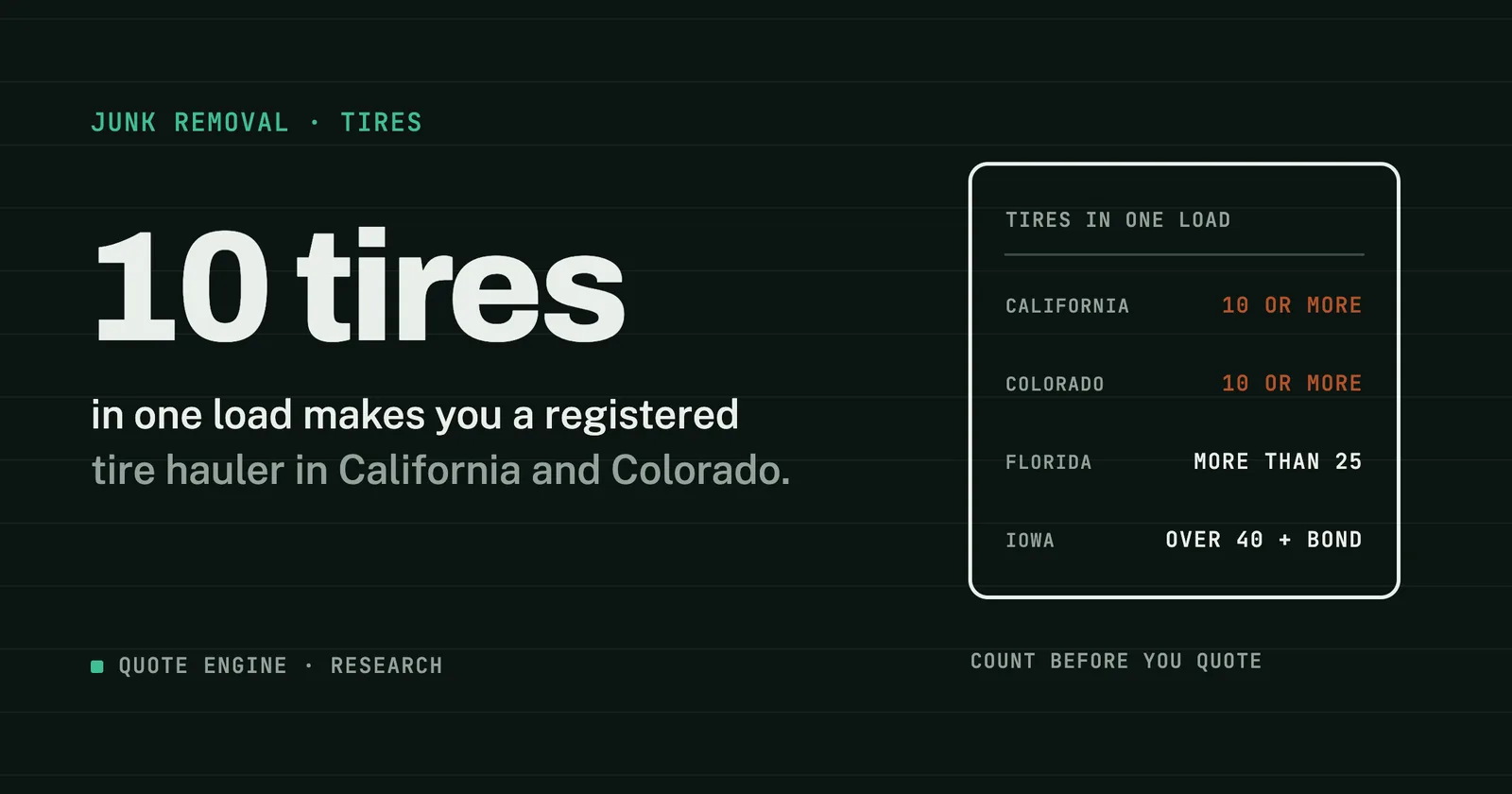
Most states regulate who may move scrap tires, because tire piles burn and breed mosquitoes. The trigger is usually a count per load, and it is lower than a lot of garage cleanouts:
| State | Registration needed at | What comes with it |
|---|---|---|
| California | 10 or more used or waste tires | Annual registration, and a trip log entry for every pickup and delivery |
| Colorado | 10 or more waste tires in one load | Registration, a decal on the vehicle, manifests kept three years, an annual report |
| Florida | More than 25 tires at a time | Registration as a waste tire collector; the rule sets a fee of $35 per vehicle and a decal on each one |
| Iowa | More than 40 tires in one load, for hire | Registration carried in the vehicle, and a surety bond of at least $150,000 |
| Texas | No count on the regulator's page | "All transporters, with a few exceptions, must register" before collecting tires, and every load is tracked on a manifest |
The Colorado number shows up at the gate, too. Larimer County's 2026 fee schedule tells customers that nine is the most tires State Law allows per trip. A tenth tire is not a tenth line on the quote. It is a different kind of business.
Florida adds a point for the customer's side. The state's own guidance says that if someone other than a registered collector takes tires away and they are dumped, the person who handed them over can be fined or made to clean up. A registration number on the quote is something a commercial customer has a reason to ask for.
The rim is a second price
Three county schedules, read the same day:
| Site | Tire off the rim | Tire on the rim |
|---|---|---|
| Larimer County, CO, car or light truck | $7.50 | $13.50 |
| Hillsborough County, FL, from 1 October 2026 | $13 | $27 |
| Jefferson County, TN, from 1 December 2025 | $2 each up to 10 residential; $160 a ton otherwise | A $40 rim-handling fee on top, $75 and loss of privileges for a repeat |
Jefferson County explains its fee plainly: its recycler penalises the county for rims, and the rims can come in separately as scrap metal at no charge. The rim is a pricing question because whoever takes it off — you or the landfill — is doing labour.
What that does to a set of eight
Our arithmetic, at the published fees:
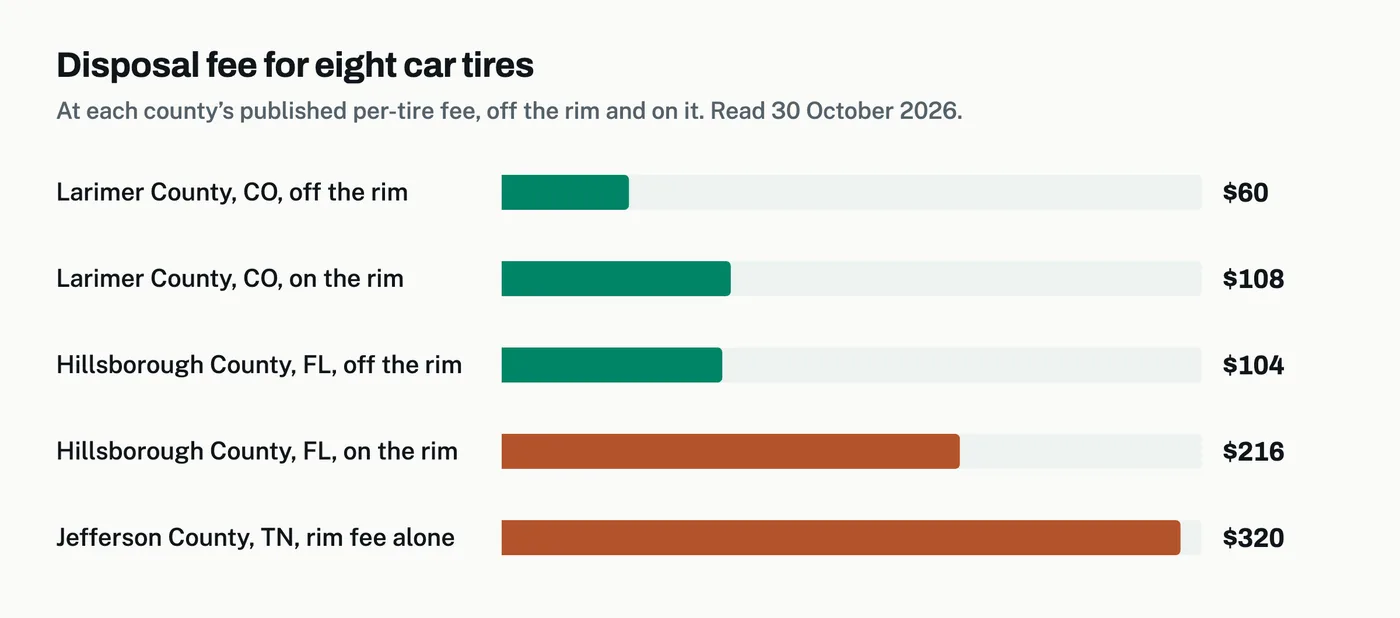
- In Hillsborough, eight tires on rims cost $216 to tip. Off the rims, $104. The rims cost $112 on their own.
- In Jefferson County, the rim fee alone on eight tires is $320, before the tonnage.
- In Colorado, the same eight tires are a legal load for an unregistered business. Ten are not.
How to put it in the price
- Ask the count, not "some tires". The number decides whether the job is legal on your current paperwork. Above your state's line, it is a job for a registered hauler or a split load — and a split load is a second trip on the quote.
- Ask "on the wheel or off?" It is the question that doubles the gate fee, and the customer can see the answer from the garage door.
- Use your own gate's figure. Per-tire fees are on the county schedule. Put that in, not a national range.
- Separate oversized tires. Larimer's schedule runs from $7.50 for a car tire to $75 for heavy equipment. A tractor tire is not "one more tire".
Where these figures come from
Registration thresholds are from each state's own statute, rule or regulator page. Florida's 25-tire line is from the Department of Environmental Protection's guidance dated May 2017, which cites Rule 62-701.200(128); the rule text we read sets the per-vehicle fee but not the count, so check with the department before relying on it. The Texas page gives no tire count either way; its exemptions are by type of haul. Iowa's figures are from the 2023 Code. County fees are from each county's own page or notice. All were read on 30 October 2026. The count of guides is our own; they are counted, not named. Nothing here is legal advice — your state's tire program is the place to confirm what applies to you.
This is the product, if you want it.
Quote Engine puts a real price on a service business's own website — built from what you already charge, and honest enough to hand over the jobs it should not price.