17 November 2026 · 6 min read
How long should a roofing estimate be valid? The shingle price came with 39 days’ notice
The window on the estimate protects you until the customer signs. The price increase is charged on the day the shingles ship.
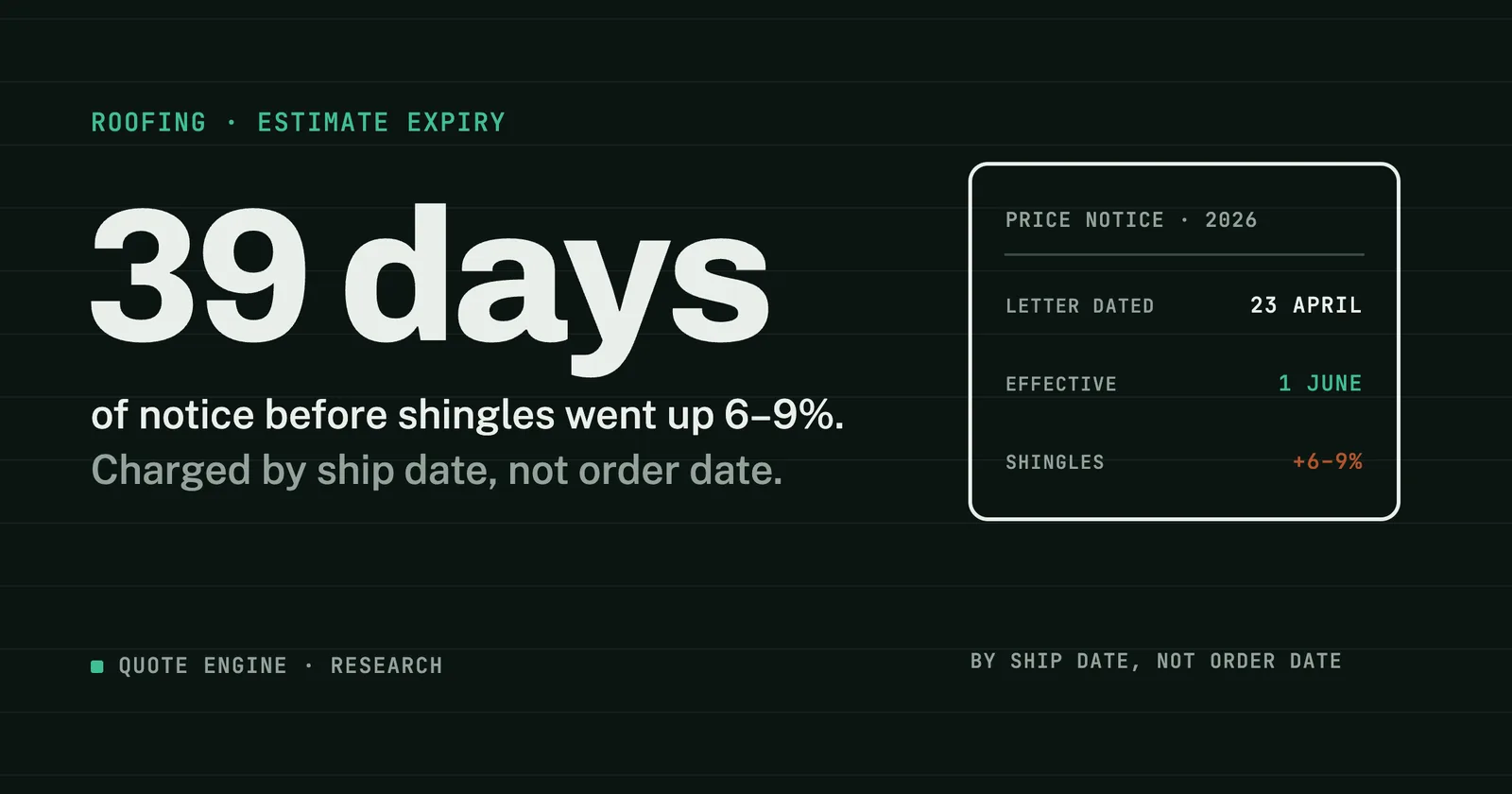
Every estimate template has a line for it: valid for some number of days. Search what the number should be and you will get an answer, a different answer, and a blank. None of them is tied to how shingle prices actually move — and in 2026 that is on the record, in writing, with dates.
What the ranking guides say
We read five owner-facing pages ranking for that search on 13 October 2026, skipping pages written for homeowners. Of the five:
- 2 of 5 give a window for roofing by name. One says 15 to 30 days. The other says 5 to 7.
- A third gives 14 to 30 days for service businesses generally, with no figure for roofing.
- 2 of 5 are roofing estimate templates that say to include an expiry and leave the number to you.
- 2 of 5 cite outside price data — lumber, copper, building materials in general.
- 0 of 5 cite a shingle price series, or a manufacturer's price notice.
So the two pages that commit to a roofing number do not overlap: the longest window on one is more than four times the shortest on the other. Neither is wrong on its face. Neither shows what it was measured against.
What the manufacturers wrote down
Shingle makers announce increases by letter, and distributors post the letters. Two of them for this year:
- GAF's letter is dated 23 April 2026 and announces "a price increase of 6-9% on all Shingles and Roofing Accessories", effective 1 June 2026. That is 39 days' notice.
- Owens Corning's letter of 30 April 2026 follows up an earlier announcement with the amount per product for the same date: $6.00 a square on its 3-tab shingle, $8.01 or $8.04 a square on every laminate and specialty shingle listed, $2.50 a bundle on hip and ridge.
Both letters carry the same condition, in nearly the same words. GAF: "All orders shipped on or after June 01, 2026 will be invoiced at the new level, regardless of order entry date." Owens Corning: effective with all shipments on or after 1 June, "regardless of order entry date."
That sentence is the one the guides are missing. The new price does not attach to the day your customer signed, or the day you placed the order. It attaches to the day the material ships.
What the index did
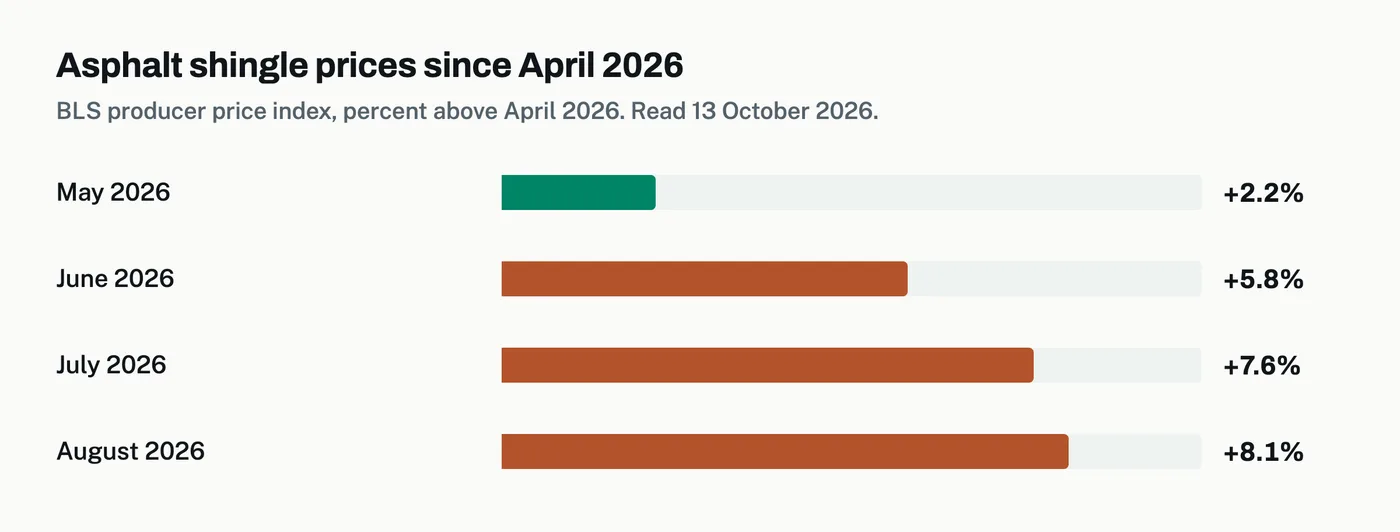
The Bureau of Labor Statistics tracks what manufacturers receive for these products. Its producer price index for asphalt shingle and coating materials stood at 349.331 in April 2026 and 377.534 in August — up 8.1 percent in four months, with 3.6 percent of it arriving between May and June alone.
The other half of the picture is what came before. The same index was 352.393 in January 2025 and 349.331 in April 2026: fifteen months, and down 0.9 percent. A 30-day window, a 7-day window and no window at all would have cost a roofer the same over that stretch, which is nothing.
It has not always been that quiet. From March 2021 to March 2022 the index went from 264.4 to 320.551, a rise of 21.2 percent in twelve months, in steps rather than in one. A window sized for 2025 would have been wrong in 2021, and the reverse.
What that does to the expiry line
Three things follow, and none of them is a number of days.
- The window is the wrong clock on its own. Take an estimate written on 5 May with a 30-day window. The customer signs on 20 May, comfortably inside it. The shingles ship on 3 June. Every square is invoiced at the new level. The expiry line did its job and you still paid the increase, because your exposure runs from the estimate to the delivery, not to the signature.
- The increase had a date before most of those estimates were written. Anything quoted after 23 April could have been priced at the June level for any job that would not ship in May. That is not a shorter window. It is two prices and a calendar.
- Size it before you rewrite your terms. On a 30-square laminate roof, $8.01 a square is $240.30 on the field shingles, before waste, starter, hip and ridge and underlayment, each of which went up as well. That is real money and it is not a reason to give a homeowner five days to decide on a roof.
Which suggests the line should say what it depends on. A window long enough for a household to make the decision, plus a plain condition: the price holds for material delivered by a named date, and a manufacturer increase announced after the estimate is passed through at the published amount. The first part is a courtesy. The second is the part that matches how you are charged.
Whether a pass-through clause is enforceable as you have written it is a question for whoever reviews your contracts, and the answer varies by state. We did not check that, and it matters.
The same problem on a website
A price on a web page has no expiry line unless someone gives it one. A range published in March and still up in July is an estimate with an unlimited window, seen by more people than you would ever hand a paper one to.
The fix is the same as on paper, and easier: the range carries the date it was last set, and the material rate behind it is one number you change on the day a letter like these arrives. Thirty-nine days is enough time to do that. It is not enough time if nobody is reading the letters.
Where these figures come from
The two price letters are the manufacturers' own, read on 13 October 2026 as hosted by ABC Supply; the Owens Corning letter refers to an earlier announcement we did not find, so its notice period is not stated here. Other manufacturers raised prices this year and are not covered. Index figures are the BLS producer price index for asphalt shingle and coating materials manufacturing, series PCU324122324122, not seasonally adjusted, read from FRED the same day, last updated 10 September 2026. It measures what manufacturers receive, not what a distributor charges a contractor, and recent months are subject to revision. Percentages and the 30-square example are our own arithmetic. The count of guides is ours, from five owner-facing pages; they are counted, not named. Nothing here is legal advice.
This is the product, if you want it.
Quote Engine puts a real price on a service business's own website — built from what you already charge, and honest enough to hand over the jobs it should not price.